
Graphing and Writing Linear Functions SOLVING EQUATIONS INVOLVING RATIONAL EXPONENTS Linear Equations and Graphing Systems of Linear Equations Solving Polynomial Equations Matrix Equations and Solving Systems of Linear Equations Introduction Part II and Solving Equations Linear Algebra Graphing Linear Inequalities Using Augmented Matrices to Solve Systems of Linear Equations Solving Linear Inequalities Solution of the Equations Linear Equations Annotated Bibliography of Linear Algebra Books Write Linear Equations in Standard Form Graphing Linear Inequalities Introduction to Linear Algebra for Engineers Solving Quadratic Equations THE HISTORY OF SOLVING QUADRATIC EQUATIONS Systems of Linear Equations Review for First Order Differential Equations Systems of Nonlinear Equations & their solutions LINEAR LEAST SQUARES FIT MAPPING METHOD FOR INFORMATION RETRIEVAL FROM NATURAL LANGUAGE TEXTS Quadratic Equations Syllabus for Differential Equations and Linear Alg Linear Equations and Matrices Solving Linear Equations Slope-intercept form of the equation Linear Equations DETAILED SOLUTIONS AND CONCEPTS QUADRATIC EQUATIONS Linear Equation Problems Systems of Differential Equations Linear Algebra Syllabus Quadratic Equations and Problem Solving LinearEquations The Slope-Intercept Form of the Equation Final Exam for Matrices and Linear Equations Linear Equations |
Linear Equations• Price-Demand Price versus quantity demanded: Symbols: • Price: p is the selling price for the TV. The quantity d of TVs sold (demanded) is related to the
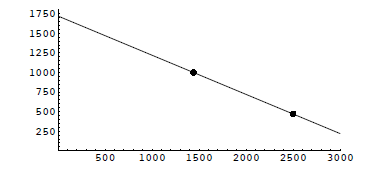
price p Can you see how the equation below reflects the relationship? Price-demand equation: d = 1720 − .50p What is the demand (in thousands) if the price is $1440? Price-demand equation: d = 1720 − .50p The demand (in thousands) if the price is $1440 is What is the demand if the price is $1441? The demand (in thousands) if the price is $2500 is What is the demand if the price is $2501? Price-demand equation: d = 1720 − .50p. Represent all such
What point above represents the situation where the price
is Price-demand equation: d = 1720 − .50p. What are some other ways to write this equation? The equation d = 1720−.50p is and example of a linear
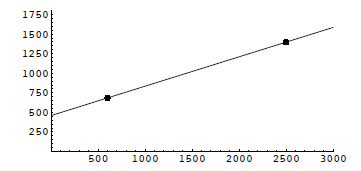
equation Price-supply: The supply equation in this case is: How does this equation match the description above? Price-supply equation: s = .375p+460. Again we can
represent
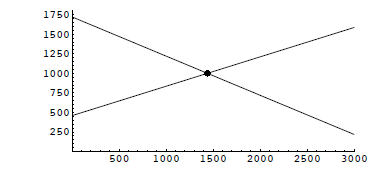
What is the supply (in thousands) if the price is $600? At what price does the quantity demanded match the
quantity Price-demand function: d = 1720 − .50p
Solve d = s. What does this have to do with the price p?
Did you Simple Interest Formula: • Principal P These are also related by a linear equation: A = P +Prt. Solve for r. What does this mean? More Practice: More Practice: |